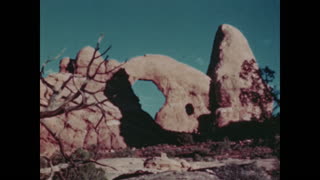
This 1950s “World School of Adventure” film entitled “Land of Crimson Cliffs” shows an expedition made by Sullivan C. Richardson and Arnold Whitaker in what appears to be a 1953 Dodge M37 truck. The pair survey the landscapes of Utah and other areas of the Red Desert, including the Navajo peoples who live in Monument Valley. The film includes footage of a Navajo family at leisure, laughing and sitting outdoors. Also documented are portions of a two-day healing chant. This ritual begins with a group of four men participating in a sweat ceremony inside a small mud hogan and once done, finishing with a ritual ablution with sand. Following this, the filmmakers record a Navajo medicine man (hataałii) carefully constructing a sandpainting (‘iikááh) depicting “Pollen Boy on the Sun.” Once complete, a little boy, of three or four years old, is set down onto the sandpainting and the medicine man begins the sing, keeping time with a rattle. Once complete, the small boy is lifted from the painting and dusted clean; off camera, the sand painting is erased. “Crimson Cliffs” was presented by Viking Pictures / 20th Century Vikings and was produced and narrated by Sullivan C. Richardson, a journalist who wrote a book entitled “Adventure South”. Richardson’s Viking Pictures was founded in 1947 in Chicago. It produced instructional and corporate films for clients.
1:24 – The narrator Sullivan C. Richardson and Arnold Whitaker set out to explore the southeastern corner of Utah, where four states meet at a single point– the Four Corners.
1:42 – It is a land of majestic crimson cliffs, arches including Utah’s famous Landscape Arch, and ancient Indian rituals, blending legends and modern realities.
3:18 – The pair traveled from Chicago to Salt Lake City and then to the magenta wonderland in Utah, accessible from various routes across the U.S.
4:04 – The area includes Monument Valley, Natural Bridges, Dead Horse Point, and other scenic spots.
4:41 – They began their journey, initially skeptical, but soon encountered a geyser and multihued canyons.
5:45 – They visited Moab and Arches National Monument, marveling at the Balanced Rock and other formations.
6:50 – They explored the windows section of the monument, feeling a sense of unreality as the sun set.
8:00 – The next morning, they continued exploring, seeing formations like the Parade of the Elephants, Park Avenue, and the Three Gossips.
9:18 – Arnold climbed Keystone Arch, showcasing its height and the challenges of the climb.
10:14 – They visited Devil’s Garden, home to Landscape Arch and Delicate Arch.
11:09 – They left the monument with regret, having only scratched the surface of what there was to see.
11:42 – They found Dead Horse Point, a spot with dramatic red light and a tragic legend of wild horses.
13:16 – The next morning, they had breakfast and continued their journey, visiting the Goblet and Natural Bridges National Monument.
16:36 – They met the custodian, Mr. Wyred, who explained the difference between arches and bridges.
17:36 – They saw three bridges: Oamo, Kachina, and Sipapu, each with unique features and names.
19:43 – They drove to the Colorado River, intending to cross on a ferry.
21:08 – The narrator recounted a previous adventure flying under Marble Canyon Bridge.
22:48 – They crossed the Colorado River on a ferry, feeling a mix of excitement and apprehension.
23:36 – They visited a cattle ranch, enjoying the company of cowboys and the fresh air.
25:06 – Their final destination was Monument Valley, known for its iconic rock formations and Hollywood film sets.
26:39 – Monument Valley is a Navajo Indian Reservation. The narrator reflects on the historical injustice of white settlers taking land from the Navajo and establishing reservations on harsh land.
27:30 – A Navajo man who invites the pair to a healing ceremony for a boy with tuberculosis.
27:54 – Sweat bath in a Hogan, where men sit around hot rocks, chanting prayers in pitch darkness.
28:45 – The men emerge from the Hogan, perspiring heavily, and dry themselves with clean sand, which they consider as clean as any towel.
29:41 – Healing ceremony begins with the creation of a sand painting as an offering to the Navajo God.
30:31 – The boy is brought out, rubbed with a potion, and seated on the sand painting. The ceremony involves chanting prayers.
31:32 – The ceremony ends.
32:02 – Leaving Monument Valley.
This film is part of the Periscope Film LLC archive, one of the largest historic military, transportation, and aviation stock footage collections in the USA. Entirely film backed, this material is available for licensing in 24p HD, 2k and 4k. For more information visit http://www.PeriscopeFilm.com