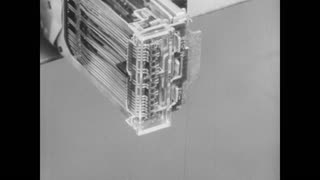
Created by Audio Productions for Bell Telephone to train employees, “Telephone Relays Wire Spring Type” dates to the early 1950s. The film describes the advantages of the wire spring type relay over older designs, highlighting its dust protection due to a transparent plastic cover. The cover should only be removed when necessary, such as for testing or adjustments. Two major adjustments may be needed: balancing spring tension and contact separation, as outlined in Bell System practices.
The repair process involves using specific tools to adjust the balancing spring and check its tension with a 70J gauge. Proper techniques are crucial to avoid damaging the spring. The film also covers adjusting contact gauging and buffer spring tension, emphasizing the importance of following correct procedures to ensure proper relay function.
Additionally, the narrator mentions the use of a special cover with test connectors for maintenance and the importance of keeping the contact cover on to prevent accidental disturbances. Proper maintenance principles should be followed, and adjustments should be made according to Bell System practices.
0:25 – 0:38: The Wies spring relay has advantages over older designs, including fewer open contacts due to dust protection from a transparent plastic cover.
0:44 – 0:57: The cover should only be removed when necessary, such as for testing or adjustments.
1:01 – 1:21: Two major adjustments may be needed: balancing spring tension and contact separation, as outlined in Bell System practices.
1:23 – 2:24: The repairman adjusts the balancing spring using a blocking tool and a spring lifter to disengage the spring legs from the card.
2:31 – 3:24: The 70J gauge checks the tension of the balancing spring legs, ensuring proper tension and adjustments.
3:31 – 4:52: Proper tools and techniques are crucial for adjusting the spring tension without damaging the spring.
5:03 – 6:06: The balancing spring legs are replaced on the card, and the armature back tension is tested with the 70J gauge.
7:01 – 8:22: Adjusting contact gauging involves bending the core plate arms to move the fixed spring assembly, checked with a gauge.
9:10 – 9:16: The protective contact cover should be replaced after adjustments.
9:18 – 10:44: The buffer spring adjustment is demonstrated, including repositioning and checking with a thickness gauge.
10:51 – 12:23: The buffer spring tension is adjusted and checked with the 70J gauge.
12:38 – 13:13: Test clips should not be connected to Wies spring contacts; a special cover with test connectors is used instead.
13:34 – 14:34: The contact cover protects the relay from accidental disturbances, such as brushing against it.
14:34 – 15:07: Proper maintenance principles should be followed, and adjustments should be made according to Bell System practices.
Motion picture films don’t last forever; many have already been lost or destroyed. For almost two decades, we’ve worked to collect, scan and preserve the world as it was captured on 35mm, 16mm and 8mm movies — including home movies, industrial films, and other non-fiction. If you have endangered films you’d like to have scanned, or wish to donate celluloid to Periscope Film so that we can share them with the world, we’d love to hear from you. Contact us via the weblink below.
This film is part of the Periscope Film LLC archive, one of the largest historic military, transportation, and aviation stock footage collections in the USA. Entirely film backed, this material is available for licensing in 24p HD, 2k and 4k. For more information visit http://www.PeriscopeFilm.com