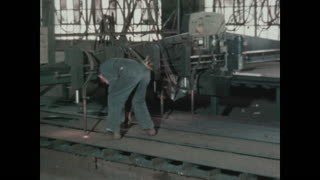
“Building the Ohio River Bridge” (1963) shows the massive construction project to build the JFK Memorial Bridge. The all metal welded truss bridge was designed by the Louisville engineering firm of Hazelet & Erdal, construction began in the spring of 1961 and completed in late 1963 at a cost of $10 million. The JFK connects Louisville, Kentucky and Jeffersonville, Indiana through southbound Interstate 65 over the Ohio River. The film highlights the the meticulous planning, specialized equipment and precise welding techniques used to build the span. Much of the film shows Allied Corporation’s training programs and tools invested in the construction project. The project’s scale involved fabricating, transporting, and assembling 71 floor beams and 1,100 cord members. The path of construction included planning and coordination between fabrication and construction divisions, the selection of specific steel pieces for specified parts and the process of welding to form bridge components.
00:00 The American Institute of Steel Construction logo appears (:09). Images of the underbelly of the bridge running over the Ohio River follow (:20). Blueprints for the massive project appear (:54). A section shows the fabrication planning stage at Allied (1:05) involving the construction division. New equipment for the project is pictured on the factory floor (1:34). Training required for the project included qualifications tests for welders (1:43) and personnel training courses (1:47). Costs of the program are discussed (1:46). A segment shows preparations for construction of the chord member (2:04) and floor beam (2:06). Delivery of steel pieces begins at the mill (2:13). Specific pieces are lifted via crane, item numbers are tacked on (2:25) and colors are sprayed on for accuracy of parts sequencing (2:43). Materials include a new type of heat-treated steel (2:51). Parts arrive at the plant; the layout of the fabricating floor in the Hammond shop (3:07) including the bay follows (3:14). Steel plates for the chords (3:30) are pictured. Welding begins with flame cutting (4:01). Butt welding follows (4:14). Welders use steel wire (4:59) and alloy plugs (5:01). After the plate is turned over (5:17), the joint is gouged out (5:30) prior to filling and grinding (6:04). An X-ray from ACTA photographs the completed joint (6:19). X-ray slides are checked (6:26). Plates go to the flame planer (6:36) for trimming (6:52). Manholes are outlined (7:18) and cut with the pantograph burning machine (7:22). Flanges are blast cleaned (7:33), set into the first fitting fixture (7:42) and squeezed together (7:48). The H section (7:56) is prepared for welding (8:30). Fitters line up plates (9:09) and prepare the cord using a cradle (9:27). Welders watch the final welding completed on a submerged arc welder (9:40). Lines are etched onto the cord (10:04) and excess metal is trimmed off (10:14). Radial drill presses (10:26) and milling machines (10:43) follow. Yellow tickets show items have passed inspection (11:08). Completed pieces go to the assembly yard (11:16). Gusset plates are positioned (11:42). Alignment (11:52) and reaming processes follow (12:08). Truss members (12:30) are carted off for bolting beginning with removal of the gusset plate (12:42). High strength bolts are used (13:04). A dial shows the calibration process of impact wrenches (13:21). Blast cleaning clears the surface (13:29) prior to painting (13:40). Butt welding of the web plates (14:02) and trimming using the fixed flame cutter follows (14:33). Flange plates and web plates are joined (14:47) using hydraulic jacks (15:03). A giant Pandjiris welding machine (15:18) and steel stiffeners are shown in use (15:57). A completed floor beam (17:17) is sent for a barge in Chicago’s Calumet Harbor (17:39). These will be taken to the erection site in Louisville Kentucky; maps show the route through water (17:51). Construction appears over the river (18:20). Temporary false work is highlighted (18:49). Floor beams (19:17) are lifted. Iron workers; 150 ft above water (19:25) work with the ground crews (19:29) in order to jockey members into place. Bolt up crews (20:43) use air powered wrenches. The unloading crane and derrick (21:15) lift cord members. Tests (22:44) preclude the final closure of the bridge (23:10). This was presented by Allied Structural Steel Company (24:06).
This film is part of the Periscope Film LLC archive, one of the largest historic military, transportation, and aviation stock footage collections in the USA. Entirely film backed, this material is available for licensing in 24p HD, 2k and 4k. For more information visit http://www.PeriscopeFilm.com