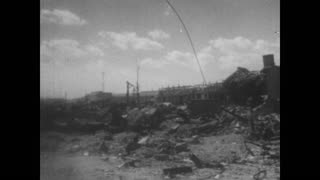
“The Crime of Korea” (1950) is a propaganda film produced by the U.S. Army Signal Corps mainly concerning war crimes committed by the North Koreans.
It is narrated by journalist Quentin Reynolds. The narrative then focuses on Communist war crimes including the Daejeon massacre: 10,000 to 25,000 victims or more. Note: in the 1990s it emerged that this massacre was actually conducted by South Korean forces against political prisoners, and propagandistically blamed on the North Koreans.
0:00 – The film opens with peaceful scenes of Korea in 1945. Reynolds recalls being a war correspondent during the arrival of USA troops accepting the surrender of Japanese forces south of the 38th parallel.
0:40 – Remembering the tranquility of the countryside and the simplicity of towns like Tjon, contrasting them with the bustling, newly liberated capital of Seoul, where citizens celebrated freedom.
1:29 – Americans are welcomed as liberators. 2:25 – Five years later, Reynolds returns to a Korea ravaged by war. The once-vibrant cities and villages lie in ruins, their people and buildings destroyed by brutal conflict.
3:02 – Liberation now comes through bitter fighting, with tanks instead of parades and bullets instead of confetti. War’s destruction is shown as relentless and devastating.
3:56 – The narrator describes the horrors beyond ordinary warfare—executions of prisoners by communists, cities like Tjon leveled, and civilians deliberately massacred to spread terror.
4:54 – Seoul’s devastation is shown next, a once-great city reduced to ashes by the conflict and fanaticism of the North Korean aggressors.
5:05 – The film highlights the coordinated efforts of UN forces—Army, Navy, Air Force, and Marines—whose victories cripple the North Korean army but cannot erase the immense civilian suffering.
6:13 – The destruction of public buildings, factories, and infrastructure symbolizes the loss of years of progress and foreign aid invested in Korea’s recovery.
6:27 – Other towns—Wanju, Chongju, Makpo, Suchon, and Yangpyong—suffer identical fates, with widespread devastation, burned homes, and massacred civilians.
7:15 – The narrator reflects on the monotony of ruin and the recurring atrocity stories, estimating around 10,000 civilians killed in Seoul, though the exact number remains uncertain.
8:20 – The United Nations begins documenting these crimes, vowing to prove their authenticity against skeptics and to pursue those responsible for killing prisoners and civilians.
8:56 – The narrator condemns not only the immediate perpetrators but also the larger cause—Communist imperialism—as the true criminal behind the Korean War.
9:46 – He laments that such suffering and destruction could have been avoided had the threat been recognized earlier, calling Korea a costly lesson for both Americans and Koreans.
10:03 – Despite victory in Korea, the narrator warns that communism remains an ongoing danger, urging vigilance and strength to prevent future conflicts.
11:12 – He asserts that all citizens—not just soldiers—share responsibility for maintaining national security and freedom, acknowledging that liberty always comes at a high cost.
12:11 – Eric Johnston appears, addressing the audience directly. He urges Americans to act against aggression by supporting national defense through unity and economic strength.
13:30 – Johnston explains that everyone has a role in rearming and maintaining defense—through work, savings, and especially buying Defense Bonds—to strengthen the nation’s economy.
14:39 – He connects the horrors shown in Korea to a broader struggle against communist aggression, encouraging citizens to invest in Defense Bonds as a means to fight back and protect freedom.
15:13 – The film ends with a patriotic appeal: joining “America’s Defense Bond Army” as a moral and practical act to prevent future wars like “the crime of Korea.”
Motion picture films don’t last forever; many have already been lost or destroyed. For almost two decades, we’ve worked to collect, scan and preserve the world as it was captured on 35mm, 16mm and 8mm movies — including home movies, industrial films, and other non-fiction. If you have endangered films you’d like to have scanned, or wish to donate celluloid to Periscope Film so that we can share them with the world, we’d love to hear from you. Contact us via the weblink below.
This film is part of the Periscope Film LLC archive, one of the largest historic military, transportation, and aviation stock footage collections in the USA. Entirely film backed, this material is available for licensing in 24p HD, 2k and 4k. For more information visit http://www.PeriscopeFilm.com